 English
 العربية
 Deutsch
 Español
 Français
 Italiano
 Português
 Русский
 Türkçe
 Tiếng Việt

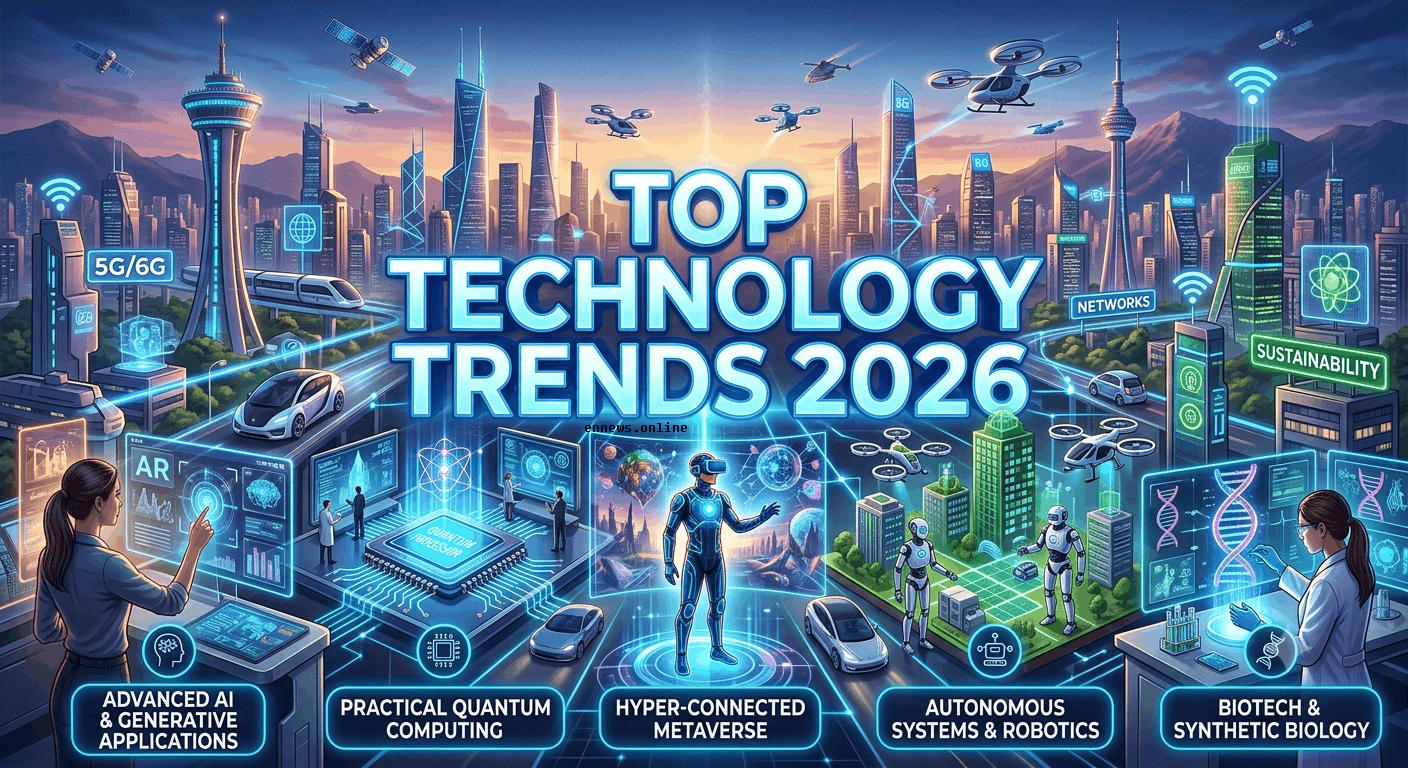
Top Technology Trends 2026: What's Actually Reshaping Business This Year
Top Technology Trends 2026: What's Actually Reshaping Business This Year
Top Technology Trends 2026: What's Actually Reshaping Business This Year
Every December, someone on your team forwards a "trends to watch" article, and most years, half of it is recycled hype dressed up as insight. This year feels different — and if you've been in any boardroom, IT meeting, or strategy session lately, you've probably already sensed it.
That's because the top technology trends 2026 aren't just incremental updates to last year's AI conversation. They represent a genuine shift in how organizations build, protect, and scale digital systems — and the gap between companies acting on these trends now and those waiting to "see how it plays out" is widening faster than usual.
This guide breaks down Gartner's top 10 strategic technology trends for 2026, explains what each one actually means in plain language, and shows how leading firms are already putting them to work. Let's start with the framework that ties everything together.
Why 2026 Feels Different: The Three Strategic Themes
Before diving into the individual trends, it helps to understand how Gartner organizes them — because the structure itself tells you something important.
Gartner groups the top strategic technology trends for 2026 into three connected themes: building strong foundations, orchestrating intelligent systems, and protecting enterprise value. In other words, it's not a random list — it's a roadmap, moving from infrastructure to execution to defense.
Insight most coverage misses: these themes aren't sequential checkboxes you complete once. Gartner's own guidance suggests organizations that skip the foundational layer and jump straight into advanced AI agents tend to face governance failures and cost overruns within the first year. Order matters here.
With that structure in mind, let's walk through what's actually on the list — starting with the foundation everything else depends on.
1. AI-Native Development Platforms
Software development itself is being rebuilt from the inside out. AI-native development platforms embed generative AI directly into the coding process, rather than bolting it on as an assistant feature.
This isn't just about writing code faster — it's about who gets to build software at all. Non-technical staff can increasingly create simple applications within governed frameworks, something that would have required a dedicated developer just a couple of years ago.
The practical effect for businesses: smaller, AI-augmented engineering teams are starting to outperform larger traditional teams on both speed and output, fundamentally changing how technical headcount gets planned.
That speed needs serious computing power behind it — which brings us to the next trend.
2. AI Supercomputing Platforms
Training and running today's AI models, especially specialized and multi-agent systems, requires processing power far beyond what standard infrastructure was built for.
AI supercomputing platforms are becoming the engine room behind everything from drug discovery timelines shrinking from years to weeks, to financial institutions running portfolio risk simulations that used to take days now completing in hours.
What most articles skip: this isn't just a "big tech" concern. As hybrid computing architecture becomes more accessible, mid-sized enterprises are starting to access this same modeling power through cloud partnerships, not just internal infrastructure builds.
Powerful computing creates powerful new risks around data exposure — and that's exactly the gap the next trend addresses.
3. Confidential Computing
As organizations process more sensitive data through AI systems, protecting that data while it's being actively used — not just stored — has become a serious technical challenge.
Confidential computing solves this by processing data in secure, isolated environments, even from the cloud providers hosting the infrastructure itself. It's the difference between locking a door and never letting anyone see what's behind it in the first place.
This matters enormously for healthcare, finance, and any industry handling regulated data through AI tools — and it's quietly becoming a baseline requirement rather than a competitive advantage.
With secure foundations in place, organizations can start orchestrating something more ambitious — multiple AI systems working together.
4. Multiagent Systems
Rather than one AI model handling everything, multiagent systems involve multiple specialized AI agents collaborating on different parts of a complex task, sometimes across entirely separate environments.
Think of it less like one very smart assistant and more like a coordinated team — one agent handles research, another drafts, another checks compliance, all communicating to complete a single business process automatically.
The real shift here: this gives organizations a practical way to automate genuinely complex, multi-step workflows — not just single tasks — while also creating new collaborative dynamics between human teams and AI systems.
General-purpose intelligence only gets you so far in specialized industries, though, which is exactly why the next trend matters so much.
5. Domain-Specific Language Models
General-purpose AI models are powerful, but they hit a ceiling in industries where precision is non-negotiable — healthcare diagnostics, legal compliance, financial reporting.
Domain-specific language models (DSLMs) are trained on specialized, industry-focused datasets, delivering meaningfully higher accuracy and compliance for critical workflows than a generalist model can offer.
This is a direct response to a real business pressure: CIOs need measurable value from AI investments, and DSLMs reduce costly errors in high-stakes use cases far more reliably than a one-size-fits-all model ever could.
If AI is moving into specialized digital workflows, the next logical step is AI moving into the physical world itself — and it's already happening.
6. Physical AI
Physical AI brings intelligence out of the screen and into the real world — powering robots, drones, and smart industrial equipment with genuine operational decision-making ability.
This isn't science fiction anymore. Manufacturing lines, logistics operations, and even agricultural equipment are increasingly running on systems that sense, decide, and act with minimal human intervention.
Why this matters more in 2026 specifically: the combination of AI supercomputing power and domain-specific models has finally made physical AI reliable enough for operational use, not just experimental pilots.
But with intelligent systems making more autonomous decisions, security can no longer afford to be reactive — which sets up the next major shift.
7. Preemptive Cybersecurity
Traditional security follows a reactive pattern: detect a threat, respond, remediate. That model simply cannot keep pace with AI-powered attacks that move in milliseconds.
Preemptive cybersecurity flips the model entirely — using AI-powered SecOps, programmatic denial, and deception techniques to predict and block threats before they strike, rather than cleaning up after the fact.
Gartner forecasts that by 2030, preemptive solutions will account for roughly half of all enterprise security spending, a clear signal that "wait and respond" is no longer considered an acceptable security posture for serious organizations.
Security isn't just about blocking attacks, though — it's also about knowing whether what you're trusting is even genuine, which is where the next trend comes in.
8. Digital Provenance
As businesses rely more heavily on third-party software, open-source code, and AI-generated content, a simple but critical question has emerged: how do you actually know where something came from, and whether it's been altered?
Digital provenance addresses this directly — using tools like software bills of materials (SBOMs), attestation databases, and digital watermarking to verify the origin, ownership, and integrity of digital assets across an entire supply chain.
The cost of ignoring this is real and quantifiable: organizations that neglect digital provenance capabilities risk significant compliance and sanction exposure as regulations around AI-generated content tighten globally.
Provenance protects trust in your data — but the AI systems themselves also need dedicated protection, which brings us to a closely related trend.
9. AI Security Platforms
As AI becomes embedded throughout business operations, it introduces an entirely new category of vulnerability — one that traditional cybersecurity tools weren't built to address.
AI security platforms specifically protect AI models, training data, and agent behavior from manipulation, data poisoning, and adversarial attacks designed to exploit the unique weaknesses of machine learning systems.
This trend works hand-in-hand with preemptive cybersecurity, but focuses specifically on a layer of risk that didn't exist at this scale until AI adoption accelerated as dramatically as it has heading into 2026.
With security covered at the technical level, there's one more trend that operates at a much broader, geopolitical scale.
10. Geopatriation
Geopatriation refers to organizations shifting their data and applications away from global public clouds toward sovereign clouds, regional providers, or on-premises infrastructure — driven largely by geopolitical risk and data residency regulations.
This isn't a niche concern. Gartner predicts that by 2030, more than 75% of enterprises in Europe and the Middle East will geopatriate at least some of their workloads, reflecting a broader global shift toward data sovereignty.
What makes this trend distinct from the others: it's less about new technology and more about where existing technology lives — a strategic decision increasingly driven by regulation and trust rather than pure performance.
With all ten trends laid out, it's worth stepping back and asking how the major consulting firms compare in their own outlooks for the year.
How Other Firms See 2026: Beyond the Gartner List
While Gartner's framework gets the most attention, it's worth knowing that Deloitte tech trends 2026, McKinsey tech trends 2026, and Capgemini top tech trends 2026 reports generally echo the same core themes — AI infrastructure, security, and trust — even when their specific terminology differs.
A detail most comparison articles miss: where these reports diverge isn't usually in which technologies matter, but in how fast each firm expects mainstream adoption to happen, and which industries they expect to move first. Cross-referencing a couple of these reports alongside Gartner's gives a more grounded, less single-source view of the year ahead.
That broader context matters — but for most readers, the real question is far more practical than industry-wide forecasting.
What This Means for Your Organization Right Now
Reading a trends list is one thing. Acting on it without burning your budget on hype is another entirely.
The smartest approach, based on how Gartner itself frames these trends, is sequential: build foundational infrastructure first (AI supercomputing, confidential computing, AI-native development), then move to orchestration (multiagent systems, domain-specific models), and only then layer in protection (preemptive cybersecurity, AI security platforms, digital provenance).
Skipping straight to flashy multiagent automation without solid security and infrastructure underneath it is exactly the pattern Gartner warns leads to governance failures within twelve months — a mistake that's far more common, and far more expensive, than most leadership teams expect.
Frequently Asked Questions
What are the top 10 strategic technology trends for 2026? According to Gartner, they are AI-native development platforms, AI supercomputing platforms, confidential computing, multiagent systems, domain-specific language models, physical AI, preemptive cybersecurity, digital provenance, AI security platforms, and geopatriation.
How does Gartner organize the 2026 technology trends? Gartner groups these ten trends into three strategic themes reflecting how organizations build foundations, orchestrate intelligent systems, and protect enterprise value.
Where can I find the Gartner top 10 strategic technology trends for 2026 PDF? Gartner publishes a full eBook and special report on its official website, available through their technology trends resource page for readers wanting the complete, detailed breakdown.
Do McKinsey and Deloitte agree with Gartner's 2026 tech trends? Largely, yes — reports from McKinsey, Deloitte, and Capgemini emphasize similar themes around AI infrastructure, security, and digital trust, though specific terminology and adoption timelines vary by firm.
What should organizations prioritize first among these trends? Foundational infrastructure trends like AI supercomputing and confidential computing should generally come first, since orchestration and security trends depend on that foundation being solid.
Final Takeaway
The top technology trends for 2026 aren't a wishlist of futuristic ideas — they're a structured response to a genuinely AI-powered, hyperconnected business environment that's already here. Organizations that treat this list as a sequential roadmap, not a buffet, are the ones positioned to lead through 2028 and beyond.
Start by honestly assessing which of these three themes — foundation, orchestration, or protection — your organization is weakest in, and build from there. That single, focused starting point matters far more than chasing every trend on this list at once.